In The Bahamas, procurement is part of the specification
Most published guidance on Bahamian roofing falls into one of two camps. Local contractors market installation services to building owners. Off island suppliers market containers and freight. Neither speaks to the person who has to write the specification and defend the schedule: the architect, the engineer, or the developer carrying the project.
That gap matters because in an island market the procurement plan and the specification are the same document. A material selection that ignores how the material gets there, in what condition, and in how many pieces, is only half a specification.
NTC is a supplier and distributor. We do not install and we do not manufacture. Installation stays with your qualified contractor, where it belongs. Our value sits where specifiers most often get stranded: matching materials to exposure, and getting them delivered complete.
Proximity is a planning advantage, not a speed promise
The Bahamas is among the closest markets we ship to, alongside Turks and Caicos. Everywhere else in the Caribbean takes longer. That is a genuine advantage, and it is worth understanding precisely, because it is smaller than people assume.
In our experience, even our closest markets are generally a week to two weeks minimum by the time a shipment leaves, reaches port, and clears customs. That is a general observation about how island procurement behaves, not a delivery commitment. We will not quote a transit time for a specific island without confirming it against the actual shipment.
The takeaway for a design team is this: plan backward from the dry in milestone, and treat clearance as a distinct step rather than a rounding error inside transit.
Being close shortens the timeline. It does not eliminate the timeline. Order to the milestone, not to the date.
Order accuracy is a schedule risk, not a paperwork risk
On the mainland, a short shipment or a wrong item is a nuisance. Someone drives to a branch and the crew loses an afternoon. In The Bahamas there is no equivalent recovery: a replacement item crosses water and clears customs again. A missing box of termination bar or the wrong flashing profile does not cost a day, it can cost weeks, with a crew idle and a building open to weather.
So we treat the takeoff and the order review as engineering work rather than clerical work. We confirm that the accessories, fasteners, flashings, adhesives, and coatings match the primary system and match each other, and that quantities reflect the actual detailing rather than a rough allowance. Getting the order exactly right the first time is the highest leverage thing anyone can do for an island roofing schedule.
Adhesives move on a different clock
One item surprises even experienced teams. Certain roofing adhesives are classified as hazardous materials. On arrival they are quarantined for roughly three days, and the forms have to be filed correctly or they simply sit.
That is predictable and solvable, but only if someone accounts for it before the order ships. We flag hazardous classified items in advance and handle the documentation, so an adhesive does not become the reason a fully staged membrane installation cannot start.
Wind belongs to the assembly, not to the product
Marketing in this region routinely implies that a panel or a membrane is itself rated for a wind speed. It is not, and specifiers should be skeptical of any material presented that way. Wind resistance is a property of the complete installed assembly: the deck, the attachment method, the fastening pattern, the edge and corner detailing, and the quality of the installation. A capable membrane on an inadequate deck will not perform the way a product sheet suggests.
What we do is supply materials appropriate to a high exposure coastal environment and provide manufacturer assembly documentation, so your specification, your engineer, and your installer work from the same intent. What we will not do is hand you a wind number attached to a product and call it a certification.
Tested against a recognized benchmark
The products we distribute, including FiberTite membrane from Seaman Corporation and the metal we supply, have passed Miami Dade product approval testing. Miami Dade is one of the more demanding product approval programs in the region, a useful benchmark for how a material behaves under weather and exposure.
It is a benchmark and nothing more. It is not a Bahamian requirement, and we do not present it as one. Your project answers to Bahamian provisions and to the local authority having jurisdiction, and those should be confirmed for the specific site by your design team rather than inferred from a testing program elsewhere.
Lead systems for Bahamian commercial work
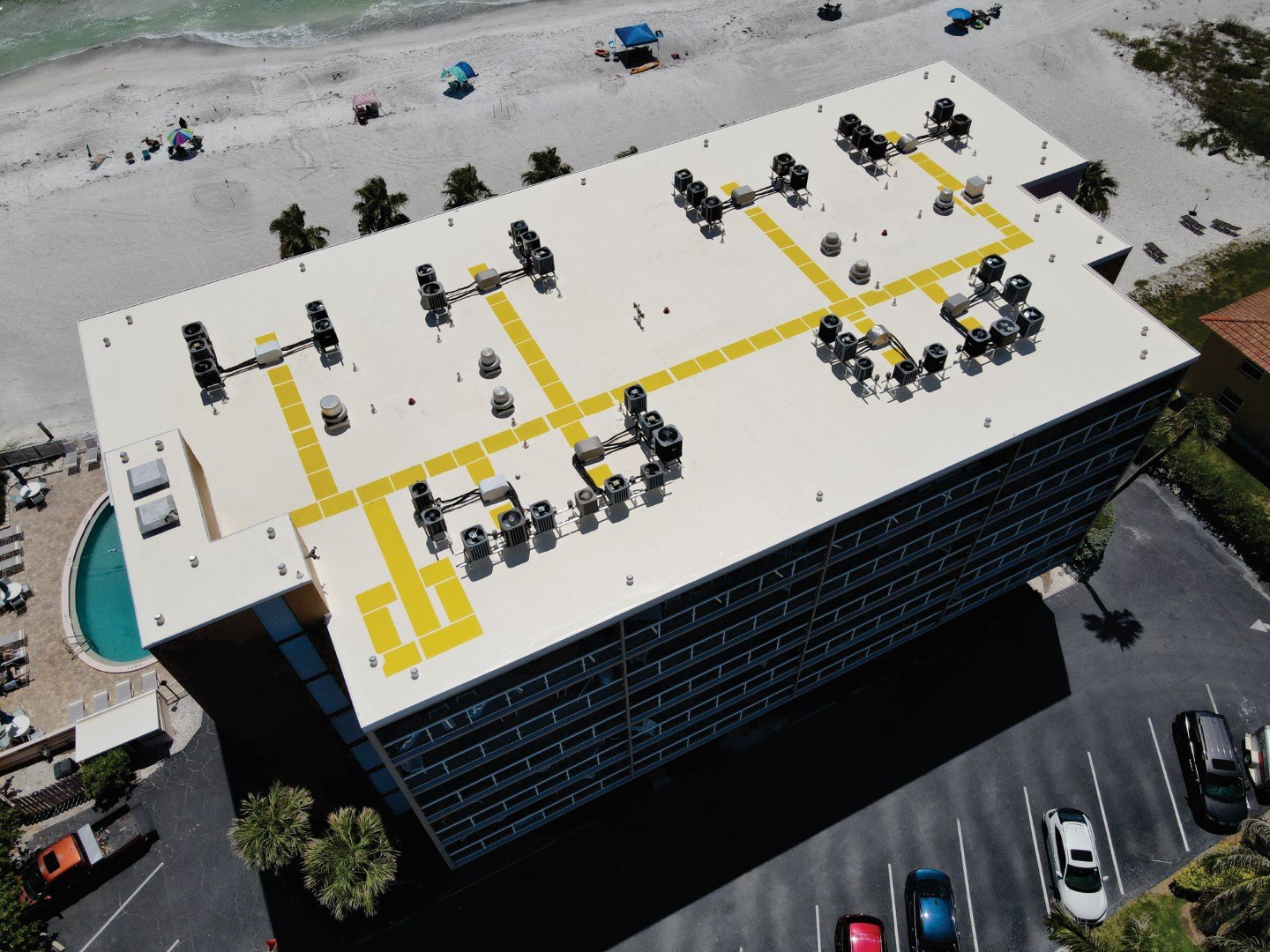
FiberTite single ply membrane for low slope roofs. Commercial, institutional, and hospitality work here is dominated by low slope assemblies, and a proven single ply system gives specifiers a well understood path for waterproofing a roof carrying significant equipment and traffic.
Coastal grade metal for sloped and highly exposed work. Salt air is the governing condition in this market, and substrate selection has to be made at design phase rather than at procurement. Once a specification is written around a lower grade substrate, the corrosion path is already set and no amount of good installation reverses it.
Around either lead system we supply the complete package: fasteners, flashings, adhesives, coatings, and accessories selected for compatibility with the primary system, so the assembly arrives as one coordinated specification rather than parts sourced separately.
Streamlined supply, and across more than one island
We hold no warehouse inventory of our own by design. Depending on the product, material ships directly from the manufacturer or through our distribution network, whichever route is most efficient for that order. On a large project that structure can return five to ten percent in efficiency to the client, and it means you receive current production material rather than whatever has been sitting on a distributor's rack.
We coordinate the logistics through the Florida port, the origin point for the freight, and arrange the sailing. Ocean freight is billed to you, but the coordination is ours, so your team is not chasing forms or managing a freight forwarder relationship. You pay the final bill rather than assembling the logistics yourself.
One planning note specific to this country: The Bahamas is an archipelago. Commercial work concentrates on New Providence and Grand Bahama, but projects in the Family Islands add a domestic leg after clearance. If your site sits beyond the main commercial centers, tell us early, because that leg belongs in the schedule from the start.
Work with NTC on your Bahamian project
Bring us the drawings, the specification section, or simply the slope and exposure conditions of the site. We will match materials to the environment, supply the assembly documentation your engineer and installer need, and build a procurement plan that treats clearance and order accuracy as the schedule risks they are. Request specifications or get a quote, and we will start with the conditions rather than a catalog.