Start with the building, not the material
There is no universally best commercial roof. The right system follows five inputs: roof slope, building type, exposure, appearance, and budget. Get those straight and the choice usually makes itself.
- Slope. Low slope and truly flat roofs shed water slowly and need a continuous, watertight surface. Sloped roofs shed fast and suit panelized systems.
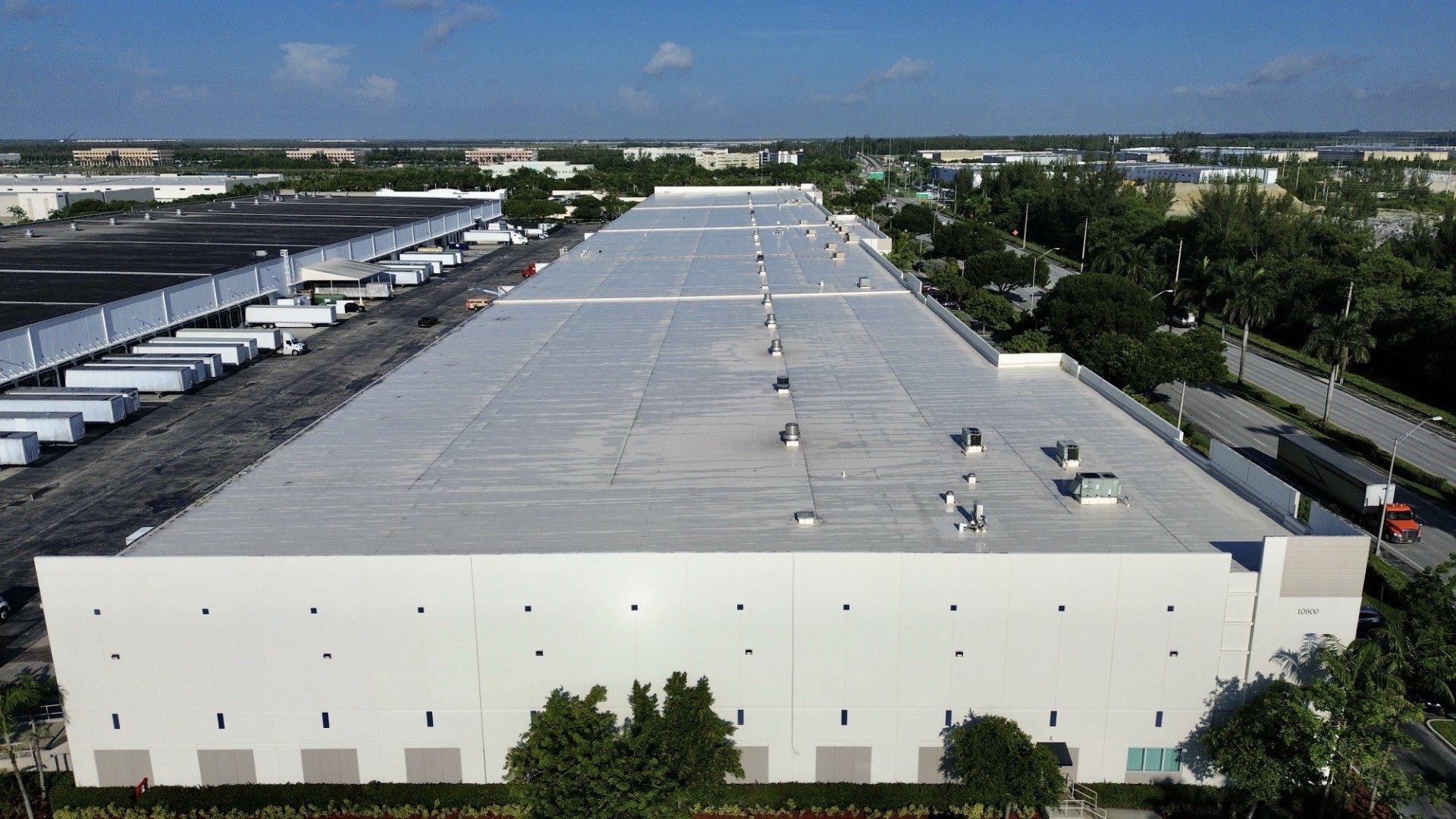
- Building type. Hotels, ports, warehouses, and large commercial tend to be low slope. Architectural buildings, entries, and feature roofs tend to be sloped.
- Exposure. On the coast, salt air drives the decision more than anything else on this list.
- Appearance. Standing seam reads as a finished architectural surface. Membrane is a performance layer, usually out of sight.
- Budget. Judge cost across the service life of the roof, not the first invoice.
As a rule of thumb for Caribbean work: low slope and flat commercial favors a single ply membrane, while sloped, architectural, and heavily coastal work favors standing seam metal.
Standing seam metal: when slope and salt are in play
Standing seam is a sloped roof system with raised, interlocking seams and concealed fasteners. Concealed fasteners matter because every exposed screw is a point of failure and a path for water and corrosion. On a coastal building, removing those points is worth a great deal.
The real decision inside metal is the substrate: aluminum versus galvalume steel. On the coast, aluminum is the safe answer. We have watched this play out. A Dominican Republic project specified cheap steel near salt water, and it rusted through in roughly five years. Aluminum would have cost about 25 percent more up front and delivered a roof in the 30 year range. That is not a close call once salt air is in the picture.
For high wind areas, specify aluminum in heavier gauges, typically .032 and .040, so the panel and its clips can carry the load. Wind performance is not a property of the metal alone. It is a property of the whole assembly and how it is fastened. NTC supplies assembly and specification guidance so the system on paper matches the system on the roof. NTC does not install.
Single ply membrane: the low slope workhorse
For flat and low slope commercial roofs, a single ply membrane is the standard answer. It is a continuous sheet, heat welded at the seams into one watertight surface, which is exactly what a slow draining roof needs. The two categories a specifier weighs most often are PVC and TPO. These are material categories, not brands.
- PVC membranes are known for chemical resistance and strong, durable heat welds. The category has a long field track record, which gives designers real long term performance data to lean on.
- TPO is a widely used, lower cost category. It reflects heat well and installs quickly. Quality varies more between formulations, and it is a newer material with less long term field history.
FiberTite is a proven single ply membrane that NTC distributes. Its formula has stayed consistent for decades, and there are 40 year old roofs in Florida that are still weldable today. For a specifier, weldability decades later is the practical test of whether a membrane is still doing its job.
Metal vs. single ply membrane at a glance
| Decision factor | Standing seam metal | Single ply membrane |
|---|---|---|
| Best slope | Sloped roofs | Flat and low slope |
| Typical building | Architectural, feature roofs, coastal | Hotels, ports, warehouses, large commercial |
| Coastal, salt air | Excellent in aluminum; avoid cheap steel | Good; not corrosion driven |
| Appearance | Finished architectural surface | Performance layer, usually hidden |
| Fasteners | Concealed, fewer failure points | Adhered or mechanically attached, welded seams |
| Service life driver | Substrate and gauge | Membrane category and weld quality |
| Wind performance | Depends on assembly and fastening | Depends on attachment and detailing |
PVC vs. TPO, kept simple
| PVC category | TPO category | |
|---|---|---|
| Relative cost | Higher | Lower |
| Chemical resistance | Strong | Moderate |
| Weld durability | Long, proven track record | Good, varies by formulation |
| Field history | Decades of data | Newer, less long term data |
| Common fit | Chemical exposure, long service life | Budget driven, reflective low slope |
On the coast, aluminum is the safe answer. Cheap steel near salt water can rust through in five years.
The Caribbean factors the generic guides miss
Most comparison guides are written for the mainland and skip what actually governs an island project.
- Salt air is the deciding variable on the coast. It is why aluminum beats steel in metal, and why substrate choice outweighs almost every other spec near the water.
- Wind is won or lost at installation. The same panel or membrane can pass or fail based on fastening pattern, clip spacing, and edge detailing. Specify the assembly, not just the material.
- Logistics shape the spec. On island projects the cost of getting it wrong is not one invoice, it is a second shipment, a second mobilization, and a roof already failing. Specifying the durable option the first time is usually the cheaper path.
- Testing as a benchmark. Both the metal and FiberTite systems NTC distributes have passed Miami Dade product approval testing. That is a recognized performance benchmark, not a Caribbean requirement, and a useful reference point when comparing systems.
How to decide
Choose standing seam metal when the roof is sloped, the building is architectural or highly exposed to salt air, and appearance matters. Specify aluminum near the coast, and heavier gauge for high wind.
Choose a single ply membrane when the roof is flat or low slope, the priority is a continuous watertight surface, and the roof is out of sight. Weigh PVC against TPO on service life, chemical exposure, and budget.
NTC is an authorized distributor, not a manufacturer or installer. We help specifiers match the system to the building and supply the assembly guidance to back it up.